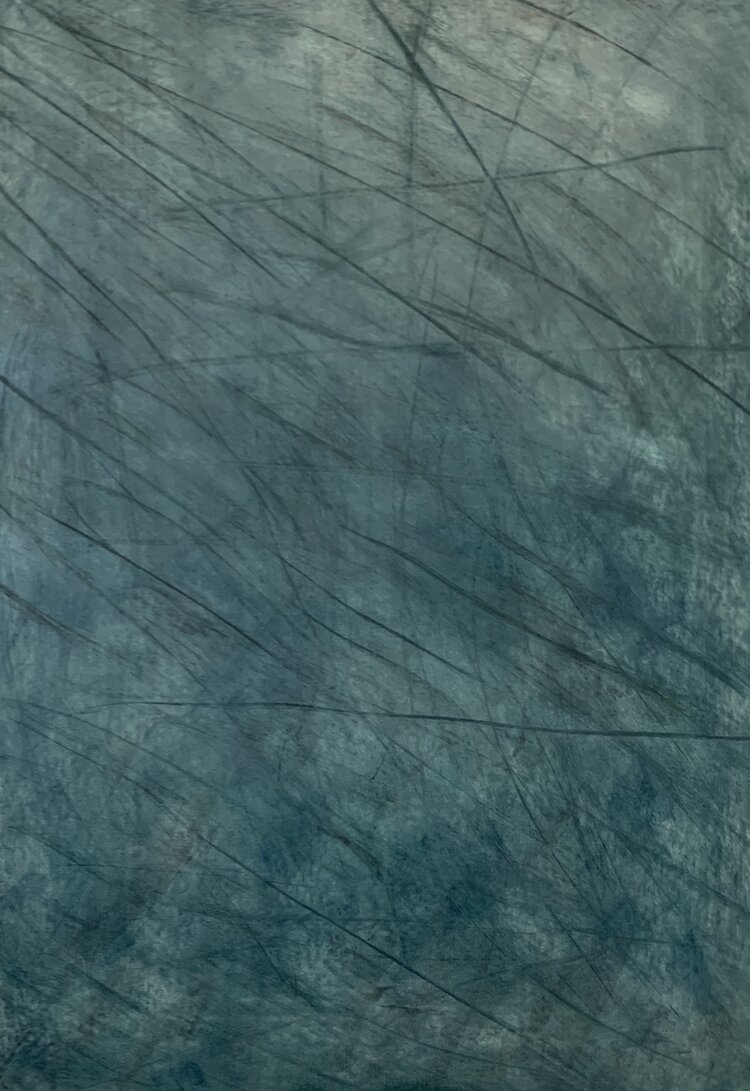


Transitional Acts: Suspension and Materiality in the Event was a practice-led exhibition and doctoral research project by artist Jill McIntosh, hosted at the Ngūtū Kaka Gallery, AUT's contemporary art space in 2023. McIntosh’s project investigated the intersection between ideas, artistic processes, and physical transformations around:
- a state of suspension: the concept of being "left hanging" without a stable ground, by suspension as a physical, psychological, and conceptual state.
- material alteration: movement, blending, and binding of dense, saturated materials. By utilizing carbon and water, the artist captures continuous, unfolding physical shifts.
- the hiatus: where the work emphasizes a "collective hiatus" or a profound moment of uncertainty and darkness that mirrors a rapidly changing, temporary world.
· Intra-action: drawing from Barad’s theory of intra-action, McIntosh views her art not as a human artist acting upon a canvas, but as an ongoing, entangled relationship where the artist, the carbon particles, the pooling water, and the environment constantly shape one another.
- the evaporating matrix and the metaphor of transience: In traditional printmaking, the matrix (the etching plate) is permanent. McIntosh replaces this with water. By floating carbon dust on a water surface and lifting it onto paper at timed intervals, the "matrix" literally evaporates and disappears over the course of the print cycle. This serves as a powerful metaphor for the dissolution of stable structures. It suggests that the frameworks we rely on to make sense of the world are temporary, fluid, and constantly slipping away from us.
Through these deliberate material choices, McIntosh ensures that the viewer does not just think about New Materialism and societal suspension—they physically walk through it, experiencing the friction between what we try to hold onto and what inevitably slips away.
The evolution of Jill McIntosh’s practice - from her early printmaking training - to her 2023 doctoral exhibition, Transitional Acts: Suspension and Materiality in the Event—is a journey from the traditional translation of printing of an image, to the fluid relinquishing of a projected outcome. The visual trajectory of this shift can be traced directly from the taught precise graphic traditions, to McIntosh's atmospheric, elemental installation spaces.
In her undergraduate degree, McIntosh learned the techniques of printmaking and image translation. Taught methods (such as etching and lithography) required an artist to manipulate a matrix—a hard plate or stone—to act as an intermediary for a final image. McIntosh absorbed the idea that printmaking is not merely replicating an image, but a philosophical process of moving a thought through a physical medium.
By shifting the ground and using monoprinting as a fluid matrix, McIntosh's practice has evolved, from the fixed multi-editioned plates of traditional printmaking toward the monoprint (a single, unrepeatable pull) where she experiments by using water as the plate. In Transitional Acts, McIntosh effectively removed the mechanical printing press entirely. Instead, she used the surface of water itself as her printing matrix. To capture the residue, she placed particulate carbon (charcoal) directly on water, laying down sheets of paper to lift the floating matter. In some works she stamped the paper at intervals, capturing the literal fading remains of the carbon. This turned printmaking into a live record of a brief physical event. In this process of working with material as ‘actant,’ instead of drawing an object with a piece of charcoal, charcoal paint was applied to horizontal paper and intentionally flooded with dripping water. The materials were left to autonomously shift, blend, and settle. Through this evolution, McIntosh transformed her printmaking to one that investigated transience, darkness, and change. She used the fundamental principles of her early graphic training to create an environment where the medium itself dictated the final outcome.
By 2023, the graphic precision of her early training expanded into immersive, environmental installations. McIntosh's charcoal drawings became "handless," allowing natural chemistry and physics to do the work. Through this evolution, McIntosh transformed her printmaking from a method of producing identical copies into an investigation of temporality.
The theoretical framework underpinning Jill McIntosh’s Transitional Acts bridges contemporary materialist philosophy with a profound observation of the modern socio-political climate. Rather than treating her artmaking as a static representation of ideas, she positions the exhibition as a live, evolving site of inquiry guided by:
New Materialism: McIntosh heavily links her practice to New Materialism, a philosophical school of thought popularized by theorists like Jane Bennett and Karen Barad.
The Agency of Matter: New Materialism rejects the traditional view that matter is passive, dead, or merely waiting to be shaped by human hands. McIntosh applies this by giving her materials equal billing as co-creators. She refers to what Bennett calls "thing power"—the autonomous energy of non-human entities. By mixing particulate carbon, water, gravity, and the airflow within the studio and gallery, McIntosh allows natural chemistry and physics to determine the final form of the work, acknowledging that the materials have their own voice and agency. Drawing from Barad’s theory of intra-action, McIntosh views her art not as a human artist acting upon a canvas, but as an ongoing, entangled relationship where the artist, the carbon particles, the pooling water, and the environment constantly shape one another.
The "Collective Hiatus" and Uncertainty. This exhibition is grounded in the psychological and societal sensation of a world caught in a state of suspended animation, mirroring global instability and rapid climate changes. McIntosh defines the "hiatus" as a profound, collective moment of pause, uncertainty, and darkness. It is the unstable gap between what was and what will be. The heavy use of deep black charcoal represents the embodiment of the void. The shifting, unfixed quality of the installations captures the fragility of human structures when confronted with vast, unpredictable elemental forces.
Suspension as a Permanent State: Rather than viewing suspension as a temporary inconvenience to be resolved, her framework repositions it as a foundational aspect of the modern human condition. To be "left hanging" becomes a space for active reflection, adaptation, and transformation. By weaving New Materialism with the concept of the Collective Hiatus, McIntosh frames printmaking and installation art as a microcosm for the macro-world: an unpredictable environment where humans must learn to yield control and navigate perpetual transition.
By conceptually mapping this experience onto particles floating in a medium – matter is left hanging, unable to find stable ground as led by the quality of darkness and intensity of affect. By lingering in this indeterminate material state – this time and change, reflects the transient world. This is the experiential, conceptual, and material state of suspension— the floating, transferring, and binding of saturated material. Jill McIntosh, Transitional Acts: Suspension and Materiality in the Event, Ngūtū Kaka Gallery, Auckland, 2023.